

We are thrilled to announce a collaboration with the Defence Science and Technology Group (DSTG) and RMIT University on an industry-focused PhD project aimed at addressing key challenges in the aerospace coating.
The project titled "Next-Gen UV-Resilient Aerospace Coatings for Enhanced Durability and Optimised Thermal Management," focuses on developing lightweight, durable, and solar-reflective aerospace coatings using nanostructured hollow particles that scatter ultraviolet radiation rather than absorb it. This aims to reduce coating weight and thermal build-up while maintaining the opacity, solvent resistance, and mechanical performance required for exterior aerospace applications. It seeks to establish the relationships between coating composition, structure, and long-term performance, and develop coating technologies suitable for demanding aerospace environments.
"UV exposure accelerates coating degradation and contributes to thermal loading on aircraft surfaces, leading to increased maintenance demands and lifecycle costs. This project addresses these challenges by exploring the integration of lightweight hollow-particle within coatings to enhance UV reflection while maintaining the durability required for aerospace applications. From a Defence perspective, the potential benefits include extended coating service life, reduced maintenance and platform downtime, and improved operational efficiency and sustainment outcomes for Defence." Lance C. Kelly, Defence Science and Technology Group (DSTG).
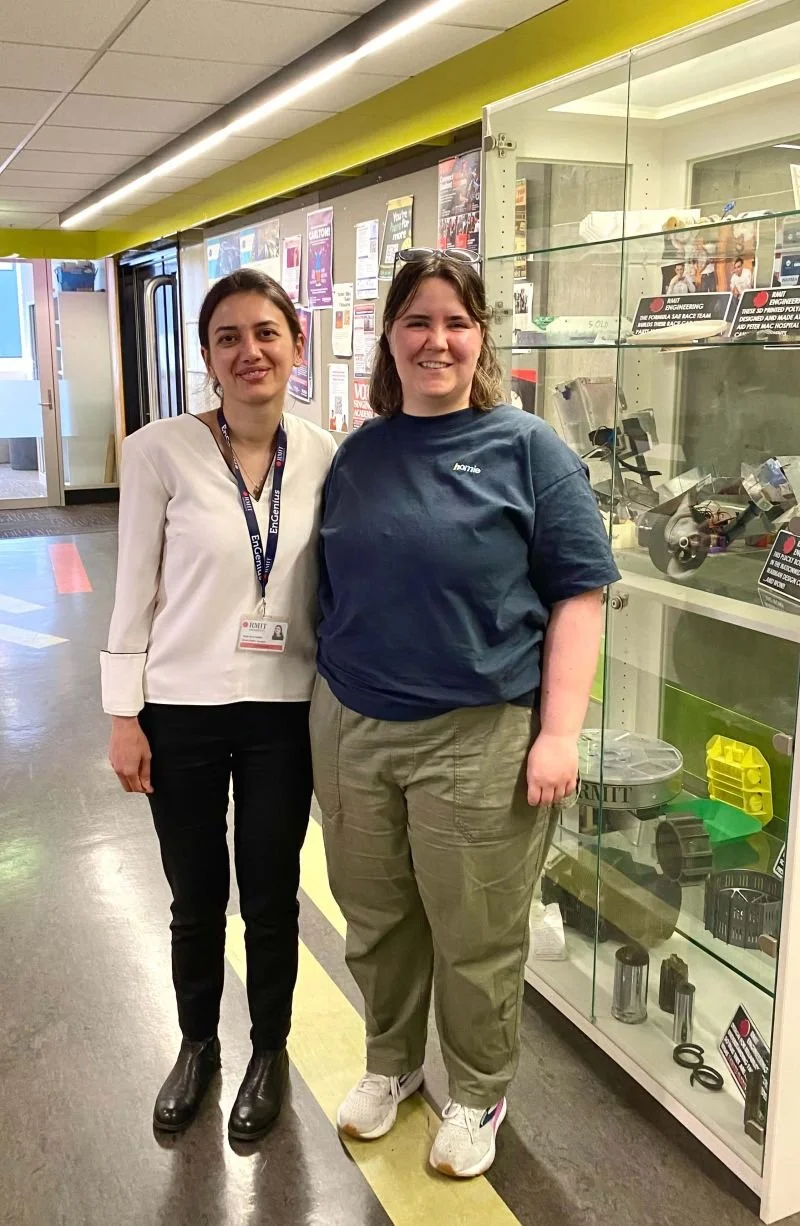
"This project allows us to connect fundamental polymer and surface-coating science with a tangible industrial challenge. It will build new research capability at RMIT University in UV-scattering hollow particles and high-performance multifunctional coatings, while strengthening our collaboration with DSTG and creating opportunities for future research in advanced aerospace materials." Dr Azadeh Mirabedini, RMIT University.
"This project gives me the opportunity to develop hands-on expertise in particle synthesis, coating formulation, thermal modelling and advanced materials characterisation, while learning how new technologies are evaluated against real aerospace and Defence standards. I am excited to work with RMIT University and Defence Science and Technology Group (DSTG) on research that has a clear pathway towards practical application." Ms. Rebekah Kate Noulton
The project is expected to deliver a lightweight aerospace coating prototype that improves UV reflection, limits solar heat absorption, and maintains the durability needed for demanding operating environments. For DSTG, the findings could contribute to protective coating technologies that extend service life, reduce recoat maintenance and aircraft downtime, and improve the operational efficiency and survivability of Defence platforms. For RMIT, the project will strengthen research and training capability in advanced coatings, aerospace materials and industry translation.