
Cost-Effective, AI-Enabled Wireless Sensing for Hidden Hazard Source Detection

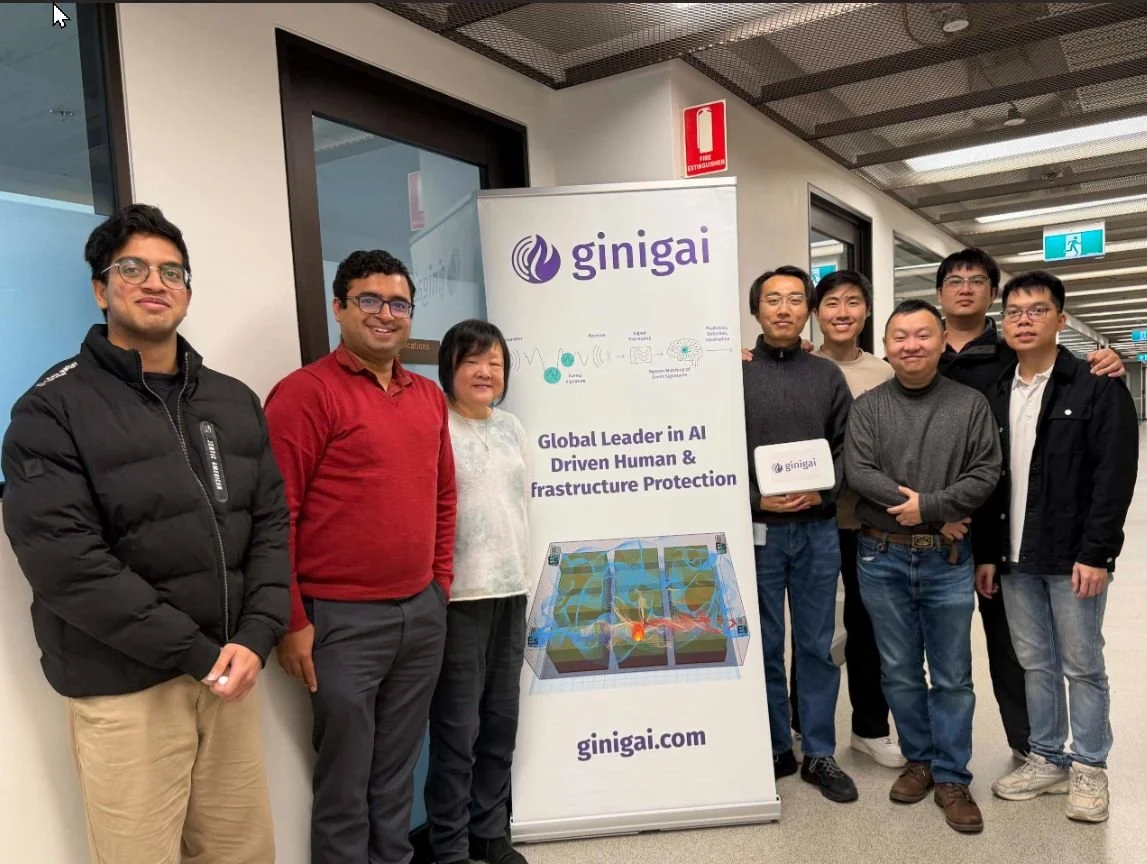
We are thrilled to announce our collaboration with Ginigai Pty Ltd and the University of New South Wales (UNSW) on an industry-focused PhD project to address key challenges in engineering and wireless sensing technologies for safety and hazard detection. This collaborative effort brings together academic expertise and industry insights to drive innovation and deliver real-world impact.
Project Overview:
The project is titled “Cost-Effective, AI-Enabled Wireless Sensing for Hidden Hazard Source Detection” and focuses on developing a wireless sensing framework capable of detecting hidden materials, hazards, and anomalies using non-intrusive radiofrequency signals. It seeks to deliver scalable, privacy-preserving sensing technologies and a deployable prototype for real-world applications across logistics, infrastructure, and industrial environments.
Collaborative Approach:
Leveraging UNSW’s expertise in wireless sensing, signal processing, and edge AI, and Ginigai’s industry leadership in sensing technologies and safety monitoring platforms, this project builds on an established collaboration. The partnership spans several years of joint research, pilot deployments, and technology validation, and will be further strengthened through co-designed research aligned to commercial product development.
Value for Industry:
The project provides competitive advantage through early access to advanced sensing methods and research expertise, accelerating the development of new safety monitoring products and expanding into markets such as logistics, maritime safety, and critical infrastructure. Anna Lowe CEO
Value for Academia:
This collaboration enables UNSW to translate cutting-edge research in wireless sensing and AI into real-world applications, strengthening industry engagement and supporting impactful, application-driven research outcomes. Deepak Mishra
Student Perspective:
This project offers the opportunity to develop advanced expertise in wireless sensing, signal processing, machine learning, and embedded systems within a dual academic–industry environment, translating research into practical technologies. Candidate - Edmond Chan
Project Outcomes/Impact:
This project will deliver low-cost, non-intrusive sensing solutions capable of detecting hidden hazards using existing RF infrastructure. It aims to improve detection accuracy while reducing infrastructure costs and enabling continuous monitoring across industrial environments. The outcomes will support safer operations, reduce risk, and provide a clear pathway to commercial deployment of AI-enabled sensing technologies in Australia and globally.
Thanks to Simon Kalucy and Artha Arthavelina.