
Optimal Dynamic Load Distribution Algorithm for Mobile Hybrid Fuel Cell-Battery Systems to Maximize Durability and Efficiency
Our collaboration with ASA Industry - Melbourne Pty. Ltd. and RMIT University on an industry-focused PhD project aims to address key challenges of mobile fuel cell-battery systems and brings academic expertise and industry insights together to deliver innovation with real-world impact.
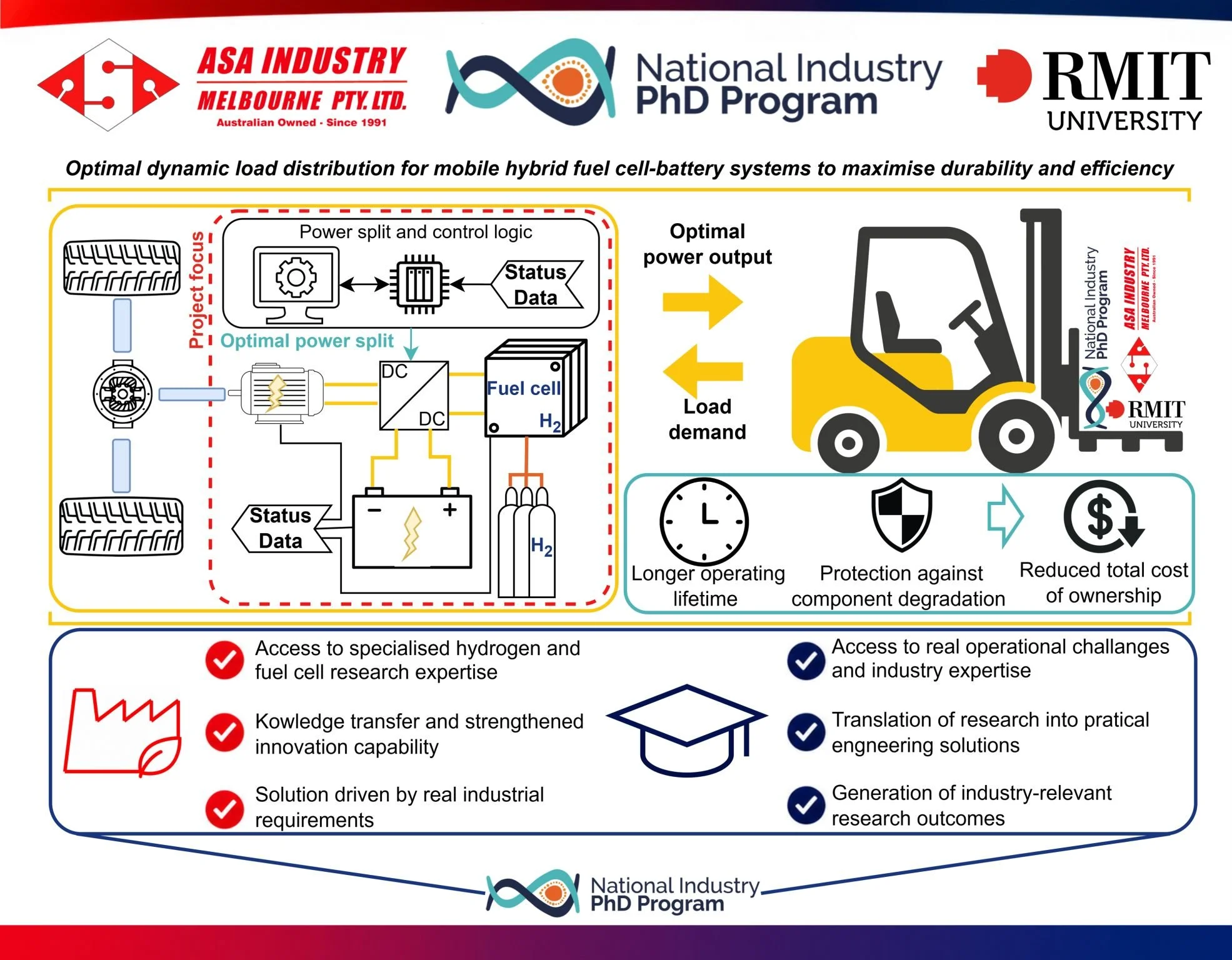
The project, Optimal Dynamic Load Distribution for Mobile Hybrid Fuel Cell-Battery Systems to Maximise Durability and Efficiency, focuses on improving the way fuel cells and batteries operate together in heavy-duty mobile applications, particularly under highly dynamic operating conditions. By gaining a deeper understanding of how different power-split strategies influence component utilisation over time, the project seeks to support more reliable, efficient, and commercially viable hydrogen-powered mobility solutions addressing current limitations of fuel cell-battery systems.
This collaboration brings together expertise of the Sustainable Hydrogen Energy Laboratory (SHEL) research group at RMIT University (School of Engineering) research group at RMIT University and ASA Industry - Melbourne Pty. Ltd. extensive experience in power electronics, electrical systems and industrial technologies. The joint approach enables the project to be driven by practical engineering requirements and real operational challenges, ensuring that the outcomes remain relevant to future industrial deployment while advancing scientific knowledge.
This cooperation provides an excellent opportunity to tackle real industrial challenges through cutting-edge academic research. Working closely with RMIT University enables us to accelerate the development of intelligent hydrogen power management technologies to be applied in a commercial context.
Through close collaboration with ASA Industry - Melbourne Pty. Ltd. and the National Industry PhD Program, the research will advance knowledge in intelligent energy management for hybrid fuel cell-battery systems while fostering the two-way exchange of expertise, perspectives, and practical experience between academia and industry.
Leon Bellinghausen- Even during my master's studies, I was fascinated by alternative propulsion technologies and their potential to transform future transportation. I am grateful for the opportunity to continue this journey through my PhD with the support of RMIT University, ASA Industry - Melbourne Pty. Ltd., and National Industry PhD Program. I look forward to contributing to practical engineering solutions that support the transition towards more sustainable transport systems.
The project is expected to generate valuable intellectual property in the field of intelligent, in situ load-distribution optimisation for hybrid fuel cell–battery systems. This will be achieved by investigating adaptive energy-management algorithms capable of making intelligent real-time decisions based on load demand, resulting operating conditions, and the progression of the system’s internal state of health.